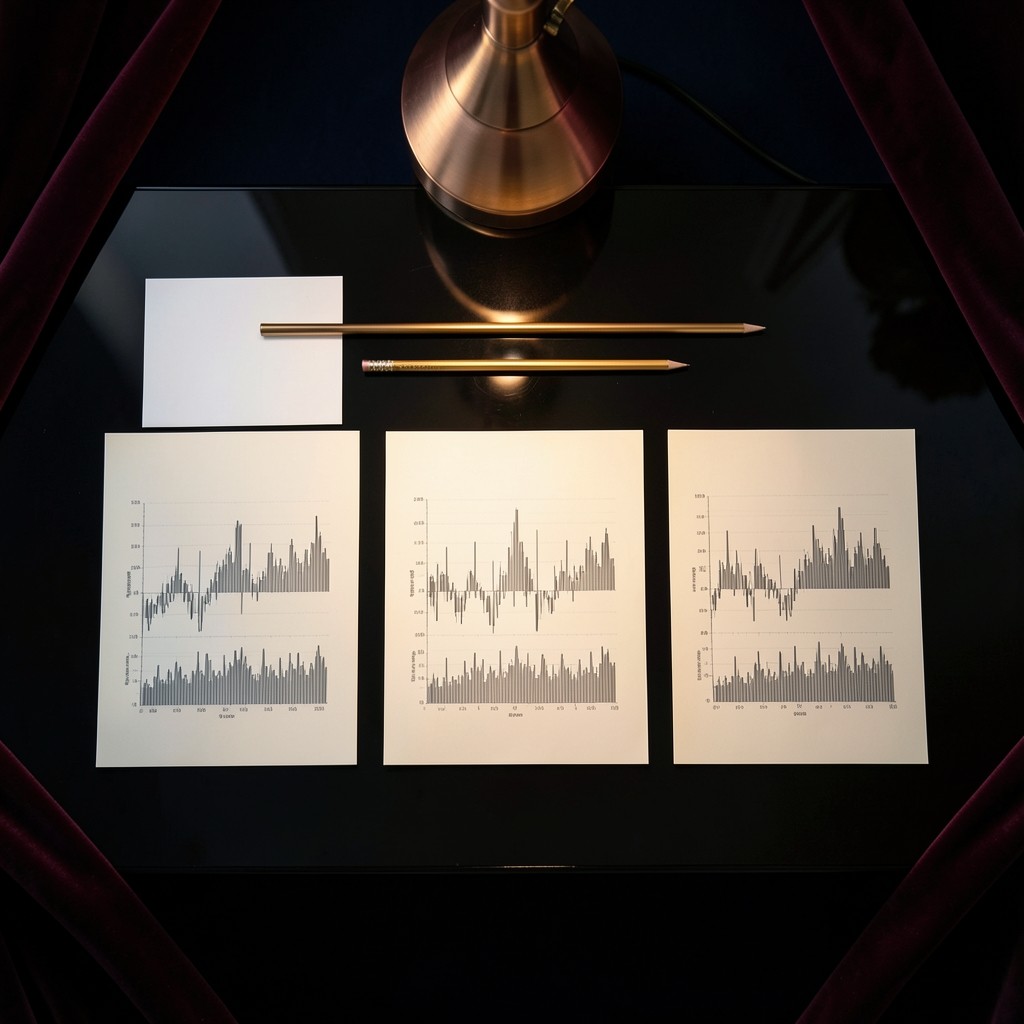
The sheets have assigned places. The pencil follows them.
Every private hour and every Saturday morning at Synap Keystone begins with the same furniture: three sheets, one lamp, and a map page that stays blank until the reading is finished.
Left · covered first
Daily
This sheet is open when you sit down. The others are face down. You and the instructor name the swing that still governs the page and write the sentence that would become false. Copper pencil only, so the marks stay distinct later.
Center · opened second
Four-hour
Turned over only after the daily sentence can be repeated. Swings are ticked from the left edge forward. Anything that neither supports nor contradicts the daily is erased before the right-hand sheet is touched.
Right · opened last
Fifteen-minute
The busy sheet. It receives the fewest marks. Areas that agree with the higher sheets get a small tick. The rest of the page is left alone, even when a recent candle looks loud.
What is written before anyone stands
The map is a single page at the top of the desk, portrait, not landscape. It receives five lines: the date, the market, the daily sentence, the four-hour swings worth keeping, and the condition that would retire the map. The fifteen-minute contribution is a place name — “only near the upper edge of the daily range,” for example — not a list of candles.
Pencils stay on a brass rail at the front edge of the desk so they are not lost under the sheets. Erasers are shared. If a mark is wrong, it is removed in the hour, not explained away in the margin. Students may photograph their own map at the end. During the reading, phones stay in bags; the lamp is for the paper.
If you are on the telephone
The posted pack is numbered to match this layout: page one daily, page two four-hour, page three fifteen-minute, page four the blank map. You work in that order while Hana does the same at the studio desk. The follow-up note refers to those page numbers so the conversation can be reconstructed without a recording.
We store your choice in this browser. Accepting or rejecting leaves the pages, forms, and sessions fully available. Read the details on the cookie page.